
Australia’s Indigenous Procurement Policy
Indigenous Procurement Policy
Introduction:
Currently, the native Australians in the country are not that many but are an integral part of the society. They first came into this country and without them Australia wouldn’t be what it is today. However, these individuals are marginalized in their own country and are trying to strive in their job or business but are unable to do so. The Australian Government felt the need to introduce procurement policy for the Indigenous individuals for them to have some means of developing their lifestyle and to improve their standard of living. The Indigenous individuals have faced a lot of verbal abuse, harassment, verbal discrimination and that too intentionally by the citizens (Cooke, Mitrou, Lawrence, Guimond & Beavon, 2017). The Australian government has introduced Indigenous Procurement Policy that aims on providing an opportunity to the Indigenous individuals; to strive in their businesses or offer them with their desired employment opportunities by granting them with awards individuals (Australian Government, 2015). The IPP was introduced on July 1st 2015 to help the Indigenous individuals to work with a good salary (Australian Government, 2020). By granting the opportunity to the Indigenous individuals they will be able to earn a hefty amount of money due to which there will be a decrease in the crime, social injustices, welfare programs and many more (Gray, Hunter & Biddle, 2014). The three main parts of the IPP to counter the issues of Indigenous individuals are: (Australian Government, 2020)
- Commonwealth and Portfolio Targets
- Mandatory Set Aside
- Mandatory Minimum Indigenous Participation Requirement.
Context:
The IPP has been a success since its initiation; the policy has granted a total of 2.5 billion dollars to the Indigenous businesses. A total of 16,842 contracts have been awarded to the 1,765 Indigenous businesses by the Australian Commonwealth (Australian Government, 2020). Through this policy the government has assigned 3 percent contracts to the Indigenous businesses currently. The target was set by the Prime Minister and Cabinet was 1.0% for the financial year of 2019-2020 that would be increased by 0.25% every year till it reaches 3% in 2027 (PwC’s Indigenous Consulting, 2019).
The Australian economy had an impact through the increase in the Indigenous Businesses and Indigenous individuals’ employment. They contributed to 0.4 percent of total Australian GDP. Currently, the total businesses of Indigenous individuals have gone up to over 11000 (PwC’s Indigenous Consulting, 2018).
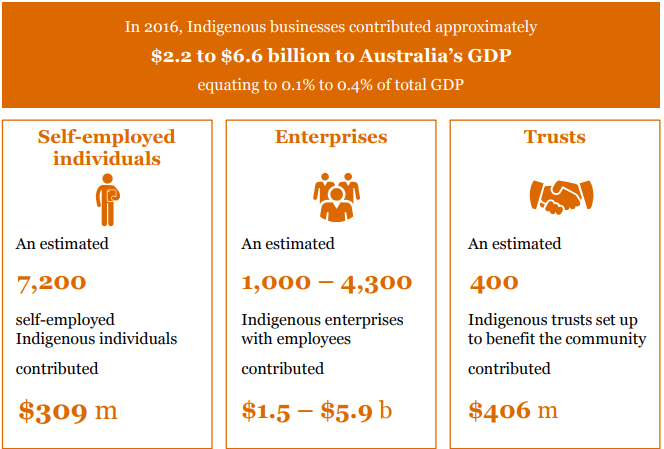
As mentioned in the introduction that through the introduction of IPP there can be a decrease in social injustices or crimes. The PwC (2018) has reported some social participation of the Indigenous individuals in the better of the country:
Self-Employed Individuals:
- Participated in the family’s stability and earned income for them
- Provided educational opportunities to the Indigenous children
- Provided training and knowledge to the Indigenous labours to attain monetary and organization skills
- They have reached up to 7200
Enterprises:
- The businesses hired over 30 percent of Indigenous labors in comparison to non-Indigenous businesses
- Provision of thorough training to the Indigenous individuals.
- Re-investment of earnings into the Indigenous society.
- They have reached up to 4300
Trusts:
- Reinstatement of the cultural expertise and inclusive duty.
- Decrease in the void between the Indigenous and the non-native societies by the introduction of replacement policies.
- Establishing of cultural supremacy and cooperative decision-making procedure.
- They have reached up to 400
The IPP has not only contributed economically to the betterment of the Indigenous people but has also contributed socially. The quantitative outcomes above have proven the economic and social improvements.
History:
The Indigenous individuals have always been in the background and are invisible for majority of the Australian. The Indigenous individuals have low employment in comparison to other non-native Australians. It was upon the government of Australia to provide the Indigenous with better employment opportunities. The reason for low employment among these individuals is due to low skills, trainings, no proper education, over dependency on the welfare programs and fewer employment opportunities. The natives as discussed have been a marginalized society in the country, the wages of the Aboriginal and Torres Strait Islander people have been managed by the government in the name of protection. Similarly, the government owe 70 million dollars only to natives of NSW (Keen, 2010). To enhance the employment opportunities for the Indigenous individuals the government has time and again introduced policies for the betterment of the natives. The policies involve Strategic Indigenous Housing and Infrastructure Program, Indigenous Opportunities Policy (IOP) and Working on Country Program. Before IPP, the policy that was working for the betterment of the Indigenous people was the IOP. (Australian Government, 2019). The IOP targeted the native individuals to train them for employment opportunities and to those Indigenous individuals who worked for small and medium enterprise. But IOP mainly focused on those areas where the population of Indigenous individuals were high and ignored the areas where the natives were working. Through this not enough native Australians were hired for a better employment (Australian Government, 2019). This was the reason for the transformation of IOP to IPP in 2015; the Indigenous Procurement Policy is a success up till now and many of the natives have started their business or are successfully employed in a good company. The three percent that is assigned by government to the IPP can really change the lives of the natives.
Welcome to MyAssignmentHelp, your ultimate destination for academic assistance. Explore our expertise in navigating the complexities of a Non-Homogeneous World and MNCs. Our skilled team offers tailored solutions, ensuring academic success amidst diverse global landscapes. Trust us for comprehensive support tailored to your needs.
Policy Analysis Framework:
The Framework that will be used to analyze the Indigenous Procurement Policy is Bacchi (WPR). This was introduced by Claudia Bacchi in 2009; the framework works differently than any other framework. This framework highlights the problems in a way that the community is governed through these problems (Bacchi & Goodwin, 2016; Walker, Higgs, Stoove & Wilson, 2020). The WPR strategy guides the researcher to criticize a policy; by critically analyzing the policy the problems in them arises on their own and is easy to detect (Bacchi, 2012). There are six key questions through which a researcher analyses the policy that are:
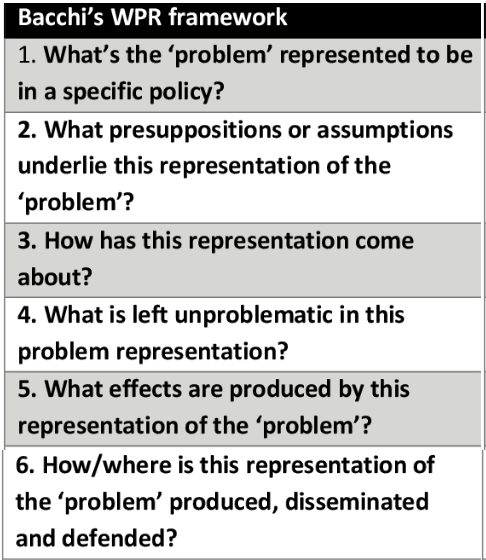
The above framework will be used for the IPP, the segment for analyses would be discussed below:
Analysis of IPP:
- The main problem of IPP was that the Indigenous individuals were not getting their basic human right that is a proper employment. It is introduced for the Indigenous to participate in the economy and help to grow their businesses so that they are not dependent on non-natives or the government. Before, Indigenous Procurement Policy the IOP was a functioning policy however, it was only offering its services to high Indigenous individuals’ populated areas and not targeting those areas where the Indigenous Australians were working. Through IOP the economy did not have that much impact like it had through Indigenous Procurement Policy (Australian Government, 2015).
- The assumptions before the IPP were:
- In order to upsurge the purchasing power of the Indigenous businesses, the Australian government should assign some percentage and apply it.
- To help the Indigenous organizations grow the Australian government should grant these organization some percentage of contracts that can help them to grow in the future.
- As the Indigenous organizations will be awarded more contracts that will encourage the businesses to employ the Indigenous individuals and increase their standard of living.
- The targets of IPP were Indigenous people, Indigenous businesses, Indigenous small and medium enterprises, Indigenous labors, the Indigenous families and the Indigenous suppliers.
- The Commonwealth Procurement Rules and Government Procurement Act 2018 focusses that the Indigenous Procurement Policy sets an extra target for the procurement of Indigenous small and medium enterprises that is the enterprises are to be owned by the Indigenous individuals by 50% or more (Organization, 2019). Moreover, the Indigenous Procurement Policy also reported to address the Indigenous enterprises by the percentage of Indigenous individuals’ holding. Hence, the IPP claims to focus more on the ownership of the business and less on how to control a business. The Indigenous businesses are made to help the Indigenous workers to get employment and benefit from the enterprises. The businesses owned by the Indigenous individuals are beneficial for the natives because these people won’t get a good job in any non-native business. According to the IPP, the focus on holding some percentage of the native enterprises may restrict the contribution of other organizations in the community (Hindle & Lansdowne, 2005).
To analyze the IPP through WPR framework, the restrictions faced by the native Australians in order to get the Government contracts that concerns with their participation in the society either socially or economically. Therefore, to address the restrictions is the duty of the society and the Government; the rise in contracts granted to these individuals will only result in growth and development of native Australian in the future as well as of the economy.
- The policy focused on the two main constructs that is to decrease the void between the Indigenous Australians and the non-native individuals. Also, through IPP the Indigenous enterprise was to be 50% or more owned by the Indigenous Australian. Additionally, there is an assumption of this policy that as the Governments will grant more of the contracts to the Indigenous enterprises there will more employment opportunities for Indigenous individuals. Through this the country will be able to get contribution from the Indigenous individuals economically as well as socially. However, it is also feared that if there are more contracts granted to the Indigenous business, the Indigenous community in Australia will become more dependent on these contracts (Mah, 2014). The IPP also includes that there will be a rise in social and cultural advantages however, they were already damaged to not enough theoretical guidance (Parkins & Mitchell 2016).
- The process of bidding contracts by the Indigenous businesses is a faulty process because this entirely focuses on ownership of the Indigenous businesses rather than controlling of the Indigenous shareholders in the organization (Denis-Smith & Loosemore, 2017). By merely focusing on ownership and Indigenous organization it can lead to ‘back cladding’; through this the non-native Australian businesses can show themselves as an Indigenous business due to the 50% ownership rule in the policy and can be awarded contracts. Through the Indigenous Procurement Policies, the non-native Australians can also portray that they are also not getting the equal opportunities for employment. It is feared that the Indigenous individuals will hide in the back as they are already quite invisible (Denny-Smith & Loosemore, 2017).
- The Indigenous Procurement Policy is introduced to address the procurement concerns for the Indigenous individuals in Australia. The IPP allows the Indigenous businesses to grow and strengthen however, it does not take into account trading or good and services. Moreover, the emphasis of awarding contracts to these Indigenous businesses of Australia but the policy does not work for the employment opportunities of Indigenous individuals in non-native business sector. Additionally, the rule of 50% or more holding of the Indigenous business should change to 50% of the ownership and the rest 50% to control the organization that will mainly include the shareholders.
Conclusion:
The Indigenous Procurement Policy was specifically designed for the Indigenous employees and Indigenous organizations to get what they deserve. Prior to IPP, IOP was functioning for the Indigenous individuals however, it was not targeting the areas where the individuals work rather it targeted those with high population of Indigenous Australians. The IPP has been a success since its initiation and has granted more than 16000 contracts to the Indigenous businesses. These businesses also contribute to the 0.4% of Australian GDP. The policy was analyzed by the Bacchi-WPR Framework that critically analyses any policy by seeking the main problem and analyzing the policy surrounding that problem. Through the WPR approach the readers can see that some problems have been identified by the framework that needs attention by the Commonwealth and the government of Australia. Other than procurement and employment the Australian government should focus on educating the Indigenous children because children are the future of the country and they can really change the face of the world. So, the Indigenous children needs high quality education without any discrimination or harassment so that they are free to do anything.
References:
Bacchi, C. (2012). Introducing the ‘What’s the problem represented to be?’approach. Engaging with Carol Bacchi: Strategic interventions and exchanges, 21-24.
Bacchi, C., & Goodwin, S. (2016). Making politics visible: The WPR approach. In Poststructural Policy Analysis (pp. 13-26). Palgrave Pivot, New York.
Hindle, K., & Lansdowne, M. (2005). Brave spirits on new paths: toward a globally relevant paradigm of indigenous entrepreneurship research. Journal of Small Business & Entrepreneurship, 18(2), 131-141.
Mah, E. (2014). An evaluation of Canada’s procurement policies for aboriginal business. Manitoba policy perspectives, 1(1), 65-81.
Organisation, D. M. (2019). Defence Procurement Policy Manual (DPPM): Mandatory Procurement Guidance for Defence and DMO Staff, Retrieved from https://defence.gov.au/casg/Multimedia/DPPMFinalv1.51July19-9-8298.pdf
Parkins, J. R., & Mitchell, R. E. (2016). Social impact assessment: A review of academic and practitioner perspectives and emerging approaches. Environmental Impact Assessment: Practice and Participation, 3rd ed.; Hanna, KS, Ed, 122-140.
[citationic]